
Vitaliy Ivanovich Pepelyashkov
Managing Director of VOTCHINA · Lawyer by training, 6 years of practice in law enforcement · over 2,600 properties checked
Legal safety · 10 min read · Checked against Ordinance No. 7/2003, the Property Act, the Condominium Management Act and the Spatial Planning Act · updated November 2026
In short
The size of an apartment in Bulgaria shown in the title deed is usually the total area: the built-up area of the home (including walls and balcony) plus a share of the building common parts. The floor area you can measure with a tape is, in our own cases, 20–35% smaller. In apart-hotels the common parts alone can be almost a quarter of the square metres you buy.
Looking at a property and not sure how many square metres you are really buying? Send us the listing — we will tell you the total, built-up and net floor area and how much of it is common parts.
Check the area on WhatsAppContents
Buyers from the UK, Germany, Ukraine or Scandinavia arrive with the habit of their own country: 40 square metres means 40 metres of floor that you can measure. At the viewing in Bulgaria they see less and ask where the rest has gone. Nobody misled them — Bulgaria simply measures differently: along the outer outline of the home, including walls and balcony, plus a share of the building common parts.
| Country | What "apartment size" means |
|---|---|
| United Kingdom | Usually sold by number of bedrooms; the floor area on the EPC is measured inside the walls, without balconies |
| Germany | Wohnfläche — the floor inside the walls; balconies and terraces usually count at 1/4 (up to 1/2) |
| Spain | Three figures, as in Bulgaria: useful, built and built with a share of common areas |
| Bulgaria | The deed shows built-up area (with walls and balcony) plus a share of the common parts; the balcony counts in full |
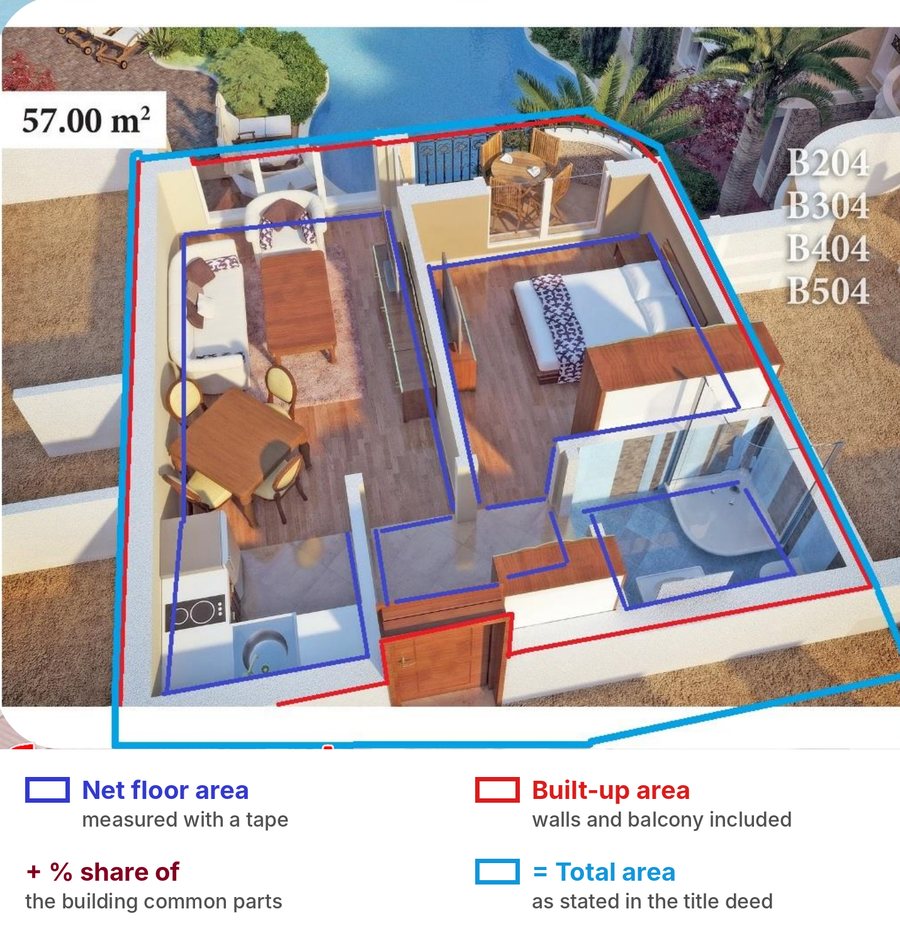
A diagram from the VOTCHINA buyer presentation: how the deed area is put together.
| Term | What it includes | Where you see it |
|---|---|---|
| Total area | built-up area + share of common parts (stairs, corridors, lobby) | title deed, listings |
| Built-up area (often called "net" on the market) | the home along its outer outline — with walls and balcony | deed, cadastral diagram |
| Net floor area | the floor inside the walls: rooms, kitchen, bathroom, hallway | architectural plan; rarely in listings |
| Living area | by law — the living rooms only, without kitchen, bathroom and hallway | projects, technical passport |
Bulgarian agents often call the built-up area "net" — so if you hear "net area", ask: "including the walls?". The area you can measure with a tape is the net floor area.
In our experience walls take around 10–15% of the built-up area — in a two-room apartment that is about the size of a bathroom.
Until 1991 balconies, loggias and terraces counted at 1/4 of their area, after that in full. So an old panel apartment and a new home with the same figure in the deed are different apartments: in the new one part of the metres is balcony, sold at the average price per square metre. In Germany a balcony usually counts at 1/4, in Spain a covered terrace at 1/2.
Under Article 38 of the Bulgarian Property Act the common parts of a building — stairs, corridors, roof, foundations, risers — belong to all owners together. With every apartment you buy a share in them. It gives you legal access to your home: nobody can claim you are walking "the wrong way". But these metres are not your rooms — you only walk through them.
| Example from our practice | Total area | Built-up | Common parts |
|---|---|---|---|
| Apartment in a resort complex, south coast | 112.09 m² | 99.31 m² | 12.78 m² — about 11% |
| Studio in an apart-complex, south coast | 43.53 m² | 33.52 m² | 10.01 m² — 23% |
In the second studio almost a quarter of the square metres bought is lobby, corridors and facilities. The deed records this as "0.073% ideal parts" — a percentage of the whole large building. Without converting it into square metres the buyer does not see how much they pay for it.
Important: "7% common parts" does not mean 7 square metres of your own. You own 7% of every common part — from foundations to roof. You cannot buy a home without them, nor "your own" metres of the corridor.
In an ordinary condominium the Condominium Management Act splits management and upkeep costs equally by number of owners and occupants (Art. 51) and repair costs by share of common parts (Art. 48). In resort complexes the fee is usually set by the contract with the management company — often in euro per square metre per year, charged on the total area including common parts.
Example: fee of about €60 per m² per year (public listings, apart-complex on the south coast, 2026)
The annual property tax is based on the tax valuation. According to the National Revenue Agency, the share of common parts is not added to the area of the home — its value is already in the base tax value. So the tax and the maintenance fee can be based on different areas.
This is a foreign buyer's first question — and it is separate from the size. The title deed will show one of three options:
| Entry in the deed | What it means |
|---|---|
| Own land plot | your own garden — usually with a house |
| Ideal parts of the land plot | you become a co-owner of the land under the building |
| Ideal parts of the right to build | the land is not yours — you hold the right for the building to stand on it (Arts. 63–67 Property Act); common in complexes |
Under the Bulgarian Constitution citizens of non-EU countries cannot acquire land, so for them an apartment with a building right is normal. Land — only through a Bulgarian company.
An example from our practice: a house with ZP 72.2 m², RZP 179.6 m² by documents and 320 m² across all levels. All three figures are legal but answer different questions. In our listings we show all three, so there are no surprises with the bank and the notary.
A "house" in a listing is not always a separate building in the documents. Before making an offer, check how it is described in the deed:
| Type | How the area is counted | The land |
|---|---|---|
| Detached house | built-up area, gross floor area and area across all levels | own land plot |
| Townhouse (wall to wall) | often a separate unit within a building — like an apartment, with a share of common parts; the shared wall counts at half | share of the land or a separate garden — according to the deed |
| House in a gated complex | its own built-up and gross floor area, like a detached house | share of the common grounds (paths, pool, security), sometimes also its own garden; maintenance fee by contract |
If the townhouse or the house in a complex is a unit within a building by documents, everything said about apartments applies: share of common parts, maintenance fee and building right.
A cellar or attic room belongs to the apartment: in the deed it is a separate line with its own area but without its own cadastral number, and it cannot be sold separately from the home. Ask whether its area is included in the figure in the listing.
A parking space in an underground garage is usually not a separate property: you buy a share of the garage and an agreed use of a specific space. The rules depend on the building design — we will cover this in a separate article.
The architectural design of every building in condominium ownership contains an area allocation table: for each apartment — built-up area, percentage of common parts, percentage of the building right, cellars and storage rooms. Ask for it before the preliminary contract, especially if you buy before Act 14: during construction the design can be amended under the Spatial Planning Act (Art. 154) and the areas can change.
The preliminary contract should state clearly: built-up area, percentage and square metres of common parts, share of the building right or of the land, cellar or storage room, and what happens if the final area differs from the agreed one.
The title deed, the cadastral diagram and the listing often show different numbers: the deed — total area, the diagram — the area of the unit, the listing — whatever the seller decided. A small difference is normal. A large difference — for example a floor or a room that is not in the documents — is a reason to check before paying a deposit: property check before a deposit.
False "The area in the deed is the floor of the apartment."
The deed shows the total area — with walls, balcony and a share of the common parts.
False "My share of the land is my garden."
It is a share in the whole plot, not a separate place. You have your own garden only with your own land plot.
Half true "Gross floor area is the whole house."
It covers the above-ground floors with terraces. A basement, garage or roof space can be outside it.
It depends "The maintenance fee is paid per square metre by law."
In a condominium — by number of owners and occupants. In complexes — under the contract with the management company. Check which area it is charged on.
In our listings we show the total area from the deed and — when we have the data — the net area and the share of common parts. For houses we show built-up area, gross floor area and the area across all levels separately. Before a viewing we tell you which area the maintenance fee is charged on. On the new page of every property you also see the full "turnkey" cost calculation.
Must read
Check in 1 minute
The built-up area of the home — with walls and balcony — plus a share of the building common parts. This is the figure in the title deed and in most listings.
Because the deed includes walls, balcony and a share of corridors and stairs. The floor you measure with a tape is, in our cases, 20–35% smaller than the total area.
Your share in the stairs, corridors, roof and foundations of the building. They give you legal access to your home but are not separate metres of your own.
In a condominium, management costs are split by number of owners and occupants under the Condominium Management Act. In complexes — under the contract with the management company, often per square metre of total area. Check the contract before making an offer.
Built-up area is the footprint of the first above-ground floor. Gross floor area is the sum of all floors including terraces and a habitable attic.
It depends on the deed: ideal parts of the land plot — yes, you are a co-owner; ideal parts of the right to build — no, the land stays with another owner.
Don't want to pay for empty square metres?
Send us the listing or the title deed — we will translate the area into clear figures and tell you what to ask the seller.
WhatsApp+359 876 111 535Viber and Telegram — same number · office@votchina.eu
Sources: Ordinance No. 7 of 2003 on rules and standards for spatial planning (Arts. 9–10); Property Act (Arts. 38, 63–67); Condominium Management Act (Arts. 48, 51); Spatial Planning Act (Art. 154); National Revenue Agency position on the area of units in condominiums under the Local Taxes and Fees Act; public sale listings (maintenance fee), November 2026.
This article is for information only and does not replace legal advice. Examples are from VOTCHINA practice, without data on specific properties or owners.